
You will learn why political fights and ethnic tensions made Singapore and Malaysia split in 1965, and how that one decision pushed both places onto very different paths. Singapore left Malaysia because leaders could not bridge deep political and communal divides, and that split set Singapore on a fast, city-state development track while Malaysia followed a more rural, multi-state course.

You will trace the build-up from the 1963 merger, the secret talks and the sudden August 9, 1965 separation, then see how each country shaped its economy, politics, and society afterward. Expect clear comparisons of nation-building, daily life today, and how ties across the Causeway still matter in Southeast Asia.
Stay with the story to find surprising links between past choices and today’s realities—how water deals, trade, and shared history keep the two countries connected even as they look and feel very different.
The Road to Merger and the Birth of Malaysia
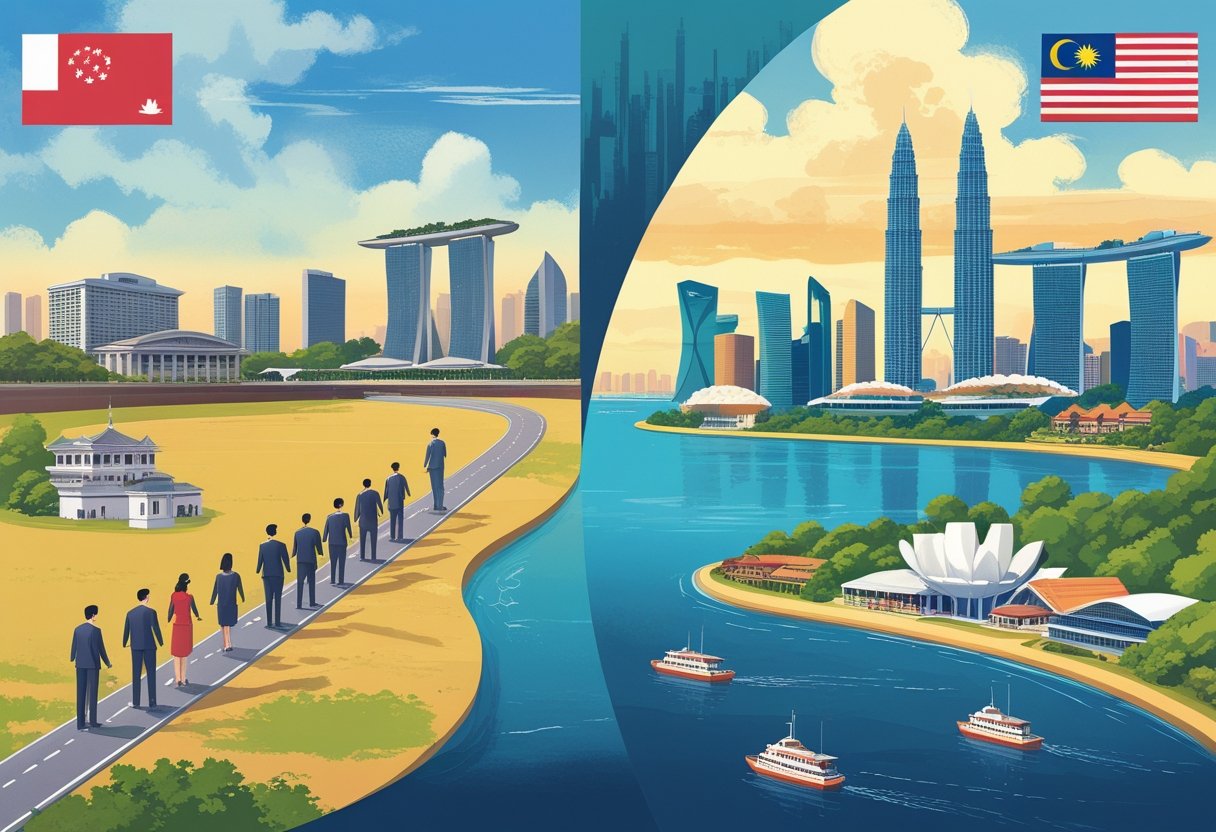
Tunku Abdul Rahman pushed for a larger federation to boost security and trade. Lee Kuan Yew and Singapore’s People’s Action Party saw merger as vital for jobs and markets. Sabah and Sarawak joined to balance geography and resources.
Reasons for the Federation
You should know leaders framed merger as a way to protect newly independent states from communist influence and to create a bigger economic market. Tunku Abdul Rahman argued that combining Malaya, Singapore, Sabah and Sarawak would secure trade routes and investment after British rule ended. Singapore’s PAP wanted access to Malaya’s hinterland and a shared customs union to help its port and industries.
Leaders also sought political stability. The Alliance Party (led by the United Malays National Organisation, UMNO) believed a wider federation would keep ethnic tensions manageable through federal arrangements. You should note economic fears, security concerns, and the appeal of a larger domestic market were the main drivers.
Key Figures and Political Parties
You will meet key people at the center of the merger story. Tunku Abdul Rahman, prime minister of the Federation of Malaya, proposed the federation in 1961 and led federal negotiations. Lee Kuan Yew, prime minister of self-governing Singapore and head of the People’s Action Party (PAP), campaigned for merger to secure jobs and sovereignty for Singaporeans.
Political parties shaped public debate. UMNO and its Alliance partners favored a federal model that protected Malay interests. The PAP pushed for terms that kept Singapore’s local control on education and labor. Opposition groups in Singapore, like Barisan Sosialis, challenged the terms and urged caution, which led to the 1962 referendum where Singapore chose conditional merger options.
Role of Sabah and Sarawak
You should understand Sabah and Sarawak joined for local and federal reasons. Both British Borneo territories wanted protection from communist insurgency and hoped federation would bring development funds and infrastructure. Their leaders negotiated safeguards for native rights, immigration control, and special autonomies during talks that led to Malaysia Day on September 16, 1963.
Sabah and Sarawak’s entry also balanced the political scale by adding territory and votes outside Malaya and Singapore. You should note that the Malaysia formation required agreements on revenue sharing and constitutional safeguards to win support in these two regions. For more detail on the wider political context, see the National Library Board’s account of the merger with Malaysia.
Irreconcilable Differences: Why Singapore and Malaysia Separated
Singapore’s exit from Malaysia grew from sharp fights over race, power, money, and law. Leaders argued loudly about who would get special rights, who would run the economy, and how the federal system should treat Singapore’s multiethnic model.
Political Ideologies and ‘Malaysian Malaysia’
You saw Lee Kuan Yew and the People’s Action Party push a multiracial, merit-based approach called “Malaysian Malaysia.”
They wanted equal treatment for all races, not policies that favored Malays. That idea threatened the Alliance Party in Kuala Lumpur, which supported bumiputera privileges to protect Malay political power.
PAP leaders like Toh Chin Chye and S. Rajaratnam campaigned in the peninsula for non-communal politics. That alarmed leaders such as Tunku Abdul Rahman and later Abdul Razak Hussein.
Parliament rows over the meaning of citizenship, education, and federal authority made compromise impossible.
Communal Tensions and Racial Riots
Communal tensions rose quickly, especially after inflammatory rhetoric and parades that stoked Malay-Chinese fears.
Violent clashes in 1964 exposed deep mistrust between communities. Those riots killed people and hardened positions on both sides.
You should note that the Malaysian leadership blamed PAP’s outreach for upsetting Malay voters. PAP argued it only sought equal rights. Meanwhile, Malay politicians pressed the federal treasury and security services to act to restore order.
The fear of further communal violence made many federal leaders see Singapore as a threat to national stability.
Economic Disputes and Trade Barriers
Economic conflict cut to the core of the union. Singapore wanted free trade within the federation and open economic policies to grow its port and industry.
The federal government prioritized protecting Malay economic interests and controlled key revenue streams, including the federal treasury.
Disputes arose over revenue sharing, customs controls, and tariffs. Malaysia imposed trade barriers and moved federal services that undercut Singapore’s economy.
Goh Keng Swee and other Singapore planners feared these moves would choke Singapore’s growth. That clash over economic policy pushed both sides further apart.
Constitutional Maneuvers and the Final Separation
By mid-1965, political leaders moved from argument to legal action. Secret talks and fast constitutional drafting prepared the formal split.
E. W. Barker drafted amendments and the Independence of Singapore Agreement 1965 that removed Singapore from the Federation.
Leaders such as Lee Kuan Yew and Kwa Geok Choo worked on legal wording to protect water agreements and citizens’ rights.
Tun Abdul Razak and Tunku factions in the Malaysian Parliament agreed that separation would stop further damage. The Malaysian Solidarity Convention and the Albatross File later showed how covert and rapid the final steps were.
After the Split: Contrasts in Nation Building and Progress
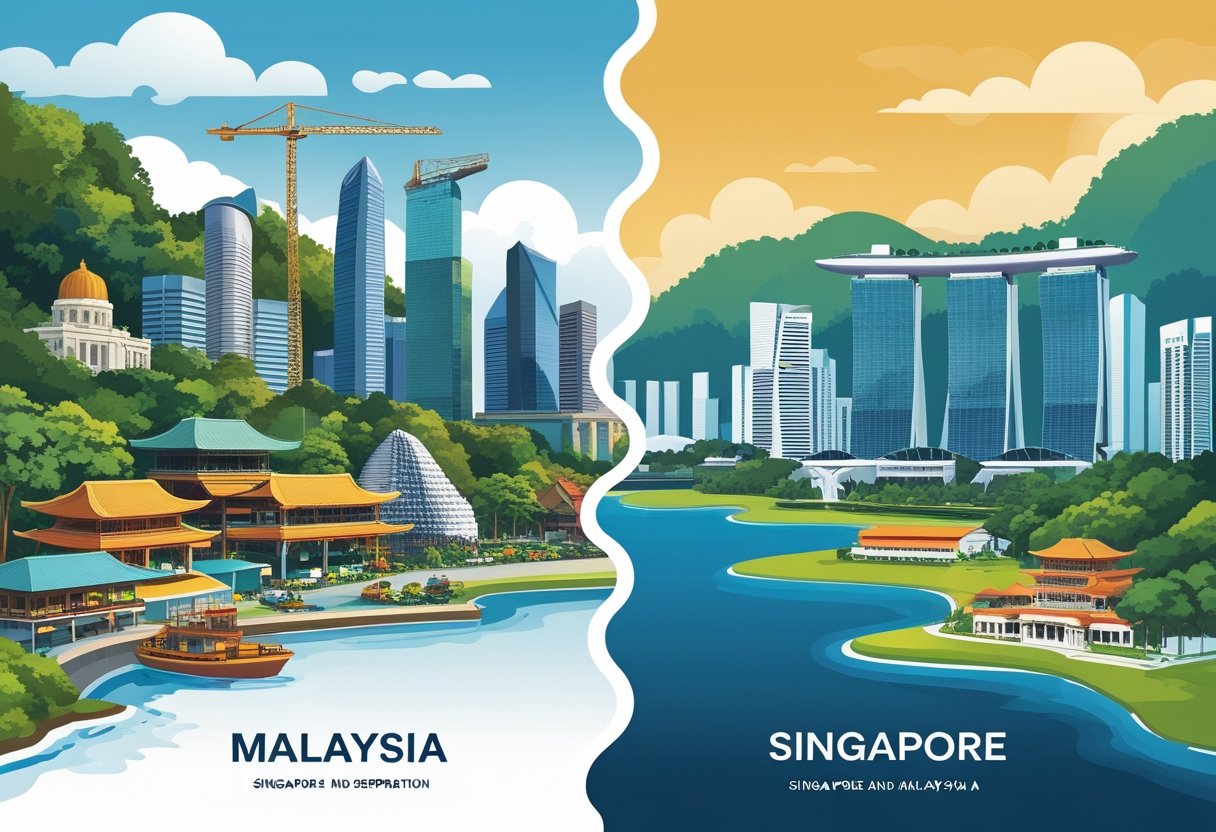
You see two neighbors take very different roads. One focused on rapid industrial growth, tight governance, and building global trade links. The other balanced development with efforts to manage ethnic diversity and political pluralism.
Singapore’s Economic Miracle
You can trace Singapore’s rise to targeted policies and big infrastructure moves. The Economic Development Board actively wooed foreign firms, turning the island into a manufacturing and finance hub. The Port of Singapore expanded into one of the world’s busiest transshipment centers, pulling in trade and shipping jobs.
Housing policy moved fast too. The Housing and Development Board built mass public flats so most citizens gained stable homes within a decade. The People’s Action Party kept tight political control, which let planners push long-term projects like advanced industry shifts and a strong Singapore Armed Forces to secure trade routes.
You experience high per-capita income, strong public services, and strict rules that prioritize order and efficiency. Singapore joined regional frameworks like ASEAN, but it mainly sold itself as a trusted place for global business and talent.
Malaysia’s Path as a Multicultural Nation
You notice Malaysia chose a different mix: economic development with explicit ethnic balancing. After separation, Malaysia pursued industrialization and resource exports while keeping policies to protect the economic position of ethnic Malays. This shaped public spending, university quotas, and business programs.
Malaysia’s federal system and more diverse party politics let states keep influence over land and local development. You still find strong ties to agriculture and natural-resource sectors alongside export industries. Malaysia stayed active in ASEAN and regional diplomacy, using its larger land area and population to play a different role than Singapore.
Efforts to build inclusive institutions sometimes slowed decision-making. You’ll see steady growth but wider income and regional differences than in compact Singapore.
Forging Distinct National Identities
You witness identity-building through different instruments. Singapore stamped a civic identity through public housing, bilingual education, and national service that the Singapore Armed Forces enforces. Symbols, public campaigns, and central planning by the PAP reinforced a merit-based, efficiency-minded national story.
Malaysia framed its identity around multiculturalism and federal patronage. Constitutional provisions and policies aimed to protect Malay interests while accommodating Chinese, Indian, and indigenous communities. Political parties organized along ethnic and regional lines, shaping how citizens see the nation.
Both countries used ASEAN membership and shared history to anchor their place in Southeast Asian history. But your experience of citizenship, daily lives, and political voice differs sharply depending on which side of the border you live.
Modern Relations and Ongoing Connections
You will see strong practical ties in trade, transport, and defence, plus deep personal and cultural links across borders. These ties mix cooperation, competition, and shared history in ways that shape daily life and national policy.
Bilateral Cooperation and Rivalry
You rely on Malaysia for land links, fresh water, and labour, while Singapore supplies investment, advanced services, and port capacity. The two governments run joint projects like the Johor–Singapore Rapid Transit System and coordinate on port and air traffic management. At the same time, you face disputes: water agreements, customs checks, and project timelines often stall talks. Defence ties reflect past tensions from Konfrontasi but now focus on exercises, intelligence sharing, and maritime security in Southeast Asia’s busy waters. Trade keeps growing, but economic rivalry appears in areas such as logistics hubs, tourism promotion, and foreign investment targeting the same regional markets.
Enduring Cultural and Social Links
Your families, food, and languages cross the Causeway every day. Malay, Chinese dialects, and English flow on both sides, and festivals like Hari Raya and Lunar New Year draw shared celebrations. Students and workers move between cities for studying and jobs, creating mixed communities in Johor and Singapore. Popular culture, TV shows, and music also travel across borders, shaping how younger generations see each other. These personal ties help smooth political tensions and keep people-focused issues—visas, cross-border schooling, and commuter services—at the top of policy agendas.

No comments:
Post a Comment